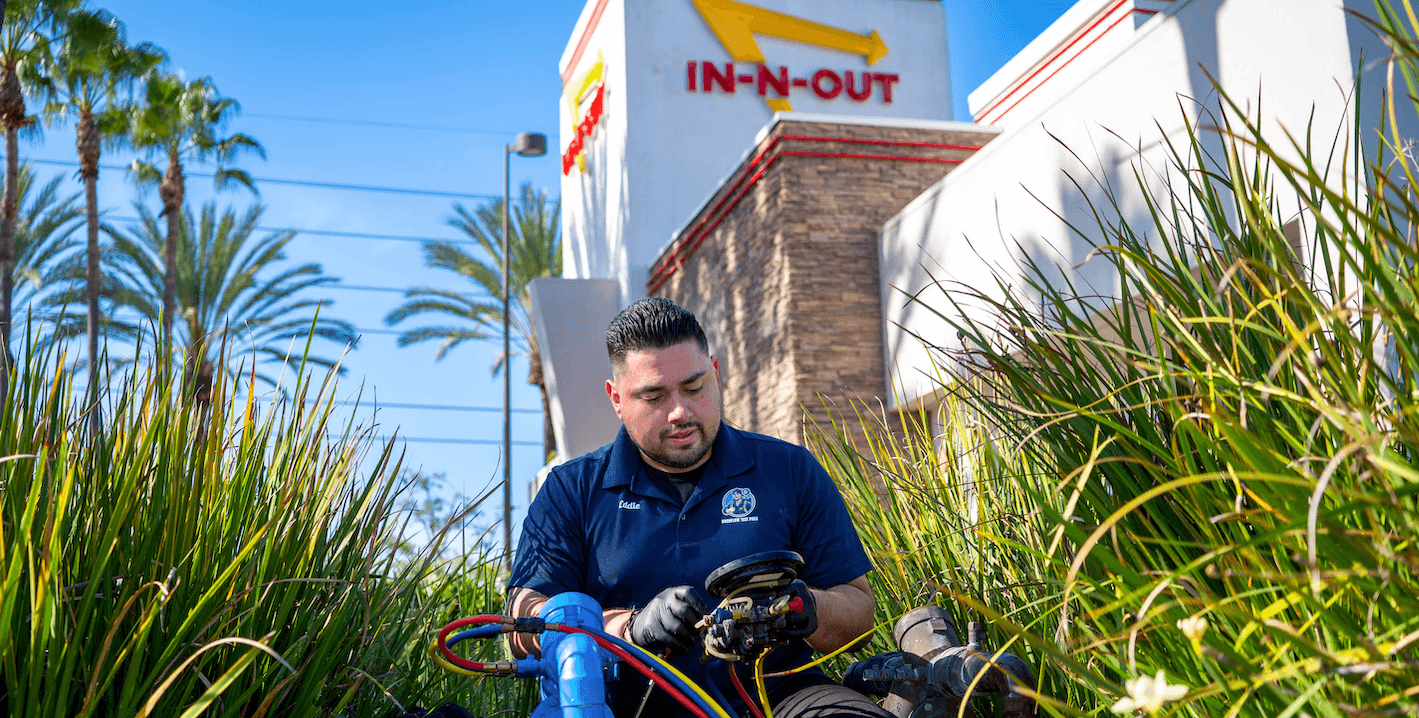


retail property shopping center Backflow Installation Municipal Compliance
Ensure you're fully compliant with specific city, county and water districts backflow prevention requirements

Retail properties and shopping centers (strip centers, enclosed malls, lifestyle centers, big-box pads, mixed-use retail) are regulated through California’s cross-connection control framework and each local water purveyor’s program. Shopping centers are often treated as moderate-to-high hazard because tenant uses vary and can change quickly. Many water purveyors require service-level containment (often RP) to protect the public system from unknown or evolving tenant hazards. As a bonded and insured licensed contractors and certified backflow testing professionals specializing in the installation, testing and repair of commercial backflow prevention assemblies, Backflow Test Pros guarantees top-tier workmanship at the most competitive rates, provides backflow repair coverage and includes 2-year installation warranty to help you meet and exceed your retail property shopping center backflow installation, testing, repair compliance requirements.
Call for Your Free Retail Property or Shopping Center Compliance Review to Qualify for Installation Warranty, Best Value Testing, Repair Coverage & Multi-Device Discounts
Installing, testing and repair of backflow preventer devices in Retail properties and shopping centers (strip centers, enclosed malls, lifestyle centers, big-box pads, mixed-use retail) is a critical component of California’s commitment to water quality protection from commercial properties connected to a public potable water system. Retail properties and shopping centers cross connection and backflow prevention responsibilities are governed by and subject to CCR Title 17 cross-connection control expectations (as administered by water purveyors), The State Water Board’s Cross-Connection Control Policy Handbook (CCCPH) (statewide minimum program expectations), the local water purveyor cross-connection programs (hazard classification, device selection, enforcement), and California state plumbing code and equipment manufacturer requirements (air gaps/indirect waste, device-specific protections). Retail properties and shopping center owners are responsible for installation, testing, repair, and ongoing compliance. Hiring a certified backflow tester to perform retail property and shopping center backflow prevention installation, testing and repair in a timely manner is key to ensuring compliance with state and municipal water department regulations. Backflow Test Pros is 100% dedicated to ensuring your property meets local water authority retail property and shopping center backflow installation, testing and repair requirements so you can avoid civil penalties and ensure your water is not turned off for noncompliance. Ensure you're fully compliant with specific city, county and water districts backflow prevention requirements Ensure your backflow assembly installation clears local permitting requirements and plans approvals Ensure your installed backflow device is USC FCCCHR approved and meets hazard level requirements Free initial backflow certification testing, same-day report submittal and backflow repair coverage
Ensure you're fully compliant with specific city, county and water districts backflow prevention requirements

Ensure your backflow assembly installation clears local permitting requirements and plans approvals

Ensure your installed backflow device is USC FCCCHR approved and meets hazard level requirements

Free initial backflow certification testing, same-day report submittal and backflow repair coverage
We provide the best value in retail property shopping center backflow prevention installations, testing and repair services by combining competitive pricing with premium service, warranty coverage and unmatched expertise.
Backflow Test Pros is an AWWA Certified Backflow Tester and Certified Backflow Tester with County Health Departments across Southern California. As a CA State licensed contractor and AWWA Certified backflow specialists, our team of experienced backflow experts work with County Health Boards and Municipal Water Departments throughout Southern California to protect our water and prevent backflow contamination.
In California, retail property shopping center backflow preventer device installation, testing and repair is governed by a combination of state regulations and local ordinances, aiming to protect the public water supply from contamination. The installation, inspection and testing of retail property shopping center backflow preventer devices are essential for ensuring the safety of drinking water from contamination by moderate to high hazard facilities at retail properties and shopping centers. Backflow risk at retail centers is driven less by “retail” itself and more by tenant diversity and common site features. Because hazards can be present or added later, purveyors often manage risk through containment at the service connection. Understanding the types of retail property shopping center backflow installation, testing, and maintenance requirements helps you avoid civil liabilities and ensures water safety compliance.
Backflow Risk at Retail Properties and Shopping Centers Arise from the Following Facility Features:
- Multiple tenant types (restaurants, salons, medical/dental, pet services, gyms, laundries) - Shared domestic services and shared irrigation systems - Fire sprinkler systems serving multiple suites - Frequent tenant improvements (TIs) and remodels - Numerous hose bibbs and maintenance washdown points - Potential for chemical use (cleaning, food service, automotive services in some centers) - Property-wide operational practices (pressure washing, landscape chemical injection) Because hazards can be present or added later, purveyors often manage risk through containment at the service connection. Some purveyors may allow DCVA containment for “low-hazard” retail-only centers, but this is less common when food service or medical tenants exist or could be added.
Depending on site design, purveyors may require: one containment assembly at the main service plus internal controls by tenant, one containment assembly at the main service plus internal controls by tenant, or separate containment assemblies per building/pad/suite (especially on separately metered services). Even when the shopping center has the required backflow containment, purveyors or building departments may require tenants to install point-of-use protection for:
- restaurants and beverage systems - medical/dental/veterinary uses - salons (chemical mixing, shampoo sinks where hoses exist) - laundries/dry cleaners - any process equipment with chemical injection or pressure systems This is especially common where a tenant’s equipment presents a clear health hazard. Additionally, retail property landscaping irrigation backflow prevention and fire sprinkler backflow assemblies are generally required and subject to annual testing review.
Retail Property and Shopping Center Backflow Violation Enforcement & Penalties
Retail centers are frequently targeted for enforcement because a single deficiency at a shared service can impact multiple tenants. Local water purveyors typically:
- issue notices and compliance deadlines - assess administrative penalties - require cross-connection surveys/inspections - terminate water service for failure to install/test/maintain required assemblies or for unresolved cross-connections
Additional Civil Liabilities
Retail property and shopping center owners and lessee businesses are exposed to additional civil liabilities resulting from contamination in the event of failure to prevent backflow into the potable water resources used by other parties.
Backflow preventers are devices installed at specific points in retail property shopping center facilities where the system connects to the public water supply. Backflow prevention devices allow water to flow in one direction. They shut off or redirect the flow if backpressure or backsiphonage is detected.
Retail Property Shopping Center Backflow Installation Requirements A. Purveyor Hazard Review & Device Approval
- The water purveyor typically determines hazard classification and specifies:
- device type (RP vs DCVA, etc.) - location (near meter/service entrance) - vault/above-grade installation requirements - New tenants or major remodels can trigger re-evaluation. B. Permits & Acceptance
- Installation typically requires plumbing permits and/or purveyor inspection.
- New/relocated/repaired testable assemblies must be tested immediately and accepted. C. Location & Accessibility Requirements (Especially for RPs)
- Must be accessible for testing and maintenance - Must have adequate clearance for shutoffs/test ports - Must be protected from flooding/submergence (or installed in an approved vault with drainage) - RP relief discharge must not create flooding or nuisance; drainage provisions may be required D. Common Installation Deficiencies
- RP installed in flood-prone vaults without adequate drainage - inadequate clearances or inaccessible assemblies (behind walls, locked enclosures without access) - incorrect orientation, missing shutoffs/test cocks - using a less protective device than required by hazard classification
At a minimum. retail properties or shopping centers are required to install an approved backflow prevention device—such as a pressure vacuum breaker (PVB), double check valve assembly (DCVA), or reduced pressure zone (RPZ) device—at the point where the retail property or shopping center connects to the potable water supply. More typically, because a single deficiency at a shared service in a retail center can impact multiple tenants, many water departments manage this backflow risk by requiring specific backflow prevention assemblies addressing tenant hazards through TI review and inspections in addition to the RP containment at the center’s main service. Additionally, state and municipal regulations require that retail property and shopping center backflow prevention devices be tested annually by a certified backflow tester to ensure proper operation. Installation must also follow strict guidelines regarding height, orientation, and accessibility to allow for inspection and servicing.
Retail Property Shopping Center Backflow Testing Requirements A. Routine Testing Frequency
- At least annually for all testable assemblies:
- domestic containment (DCVA/RP) - fire assemblies (DCDA/RPDA) - irrigation assemblies (PVB/RP) - any testable point-of-use assemblies required by the purveyor
Some purveyors require more frequent testing if the premises is designated high hazard or has repeated failures. B. Triggered Testing (Always Required) Testing is required:
- immediately after installation - after repair/rebuild - after relocation - after replacement - after plumbing modifications affecting protected lines - after suspected backflow incident or cross-connection discovery C. Tester Qualification & Reporting - Testing must be performed by certified testers recognized/approved by the purveyor.
- Reports must be submitted by the deadline via portal/forms. Retail Property Shopping Center Backflow Repair & Failure Response Requirements A. Corrective Action - repair or replace promptly - retest to confirm passing operation - unresolved failures may trigger enforcement and potential service interruption B. Repair Standards - Manufacturer-approved parts and rebuild kits only - No field modifications that compromise listing/approval C. Replacement Triggers Replacement is commonly required when:
- repeated failures occur - corrosion/cracking or compromised seating surfaces exist - assembly is obsolete or no longer accepted - location/access/drainage issues require relocation/replacement
Failure to comply with these retail property and shopping center related backflow installation, testing and repair regulations can result in fines, disconnection of service, or other enforcement actions. Retail property and shopping center owners operators may call us or consult their local water authority or building department to ensure their retail tenants at meet all applicable backflow prevention requirements.
Because retail properties and shopping centers include many High-Risk tenant categories it is doubly important that you perform an extensive cross connection and backflow prevention compliance review to avoid penalties, water disruptions and civil liabilities. Many purveyors manage this by requiring RP containment at the center’s main service, then addressing tenant hazards through TI review and inspections. High-Risk Tenants commonly include:
- Restaurants / Food courts / Coffee shops (carbonators, dishwashers, mop sinks, grease areas) - Medical / Dental / Veterinary (biohazards, sterilizers, vacuum systems, chemical disinfection) - Salons / Spas (chemical mixing, spray hoses) - Gyms (chemical cleaning, hose connections; sometimes pools/spas) - Daycare / Schools (hose use, kitchens) - Laundromats / Dry cleaners (chemicals, boilers, treatment systems)
- Automotive services (if present: oils, solvents, washdown, pressure systems)* Restaurants / Food courts / Coffee shops (carbonators, dishwashers, mop sinks, grease areas)
Call Us for Your Retail Property Shopping Center Backflow Compliance Review to Ensure You are Not in Violation of State and Local backflow Prevention Requirements 1. Confirm hazard classification with the purveyor (mixed-use centers often high hazard). 2. Verify domestic service containment device type (commonly RP). 3. Confirm fire service backflow requirement (DCDA vs RPDA/RP) and testing schedule. 4. Confirm irrigation backflow protection (PVB vs RP; chemical injection triggers RP commonly). 5. Ensure annual testing is scheduled for all testable assemblies. 6. Track tenant improvements and re-evaluate hazards when tenants change. 7. Repair failed devices immediately and retest. 8. Maintain a complete compliance record set for audits/inspections.