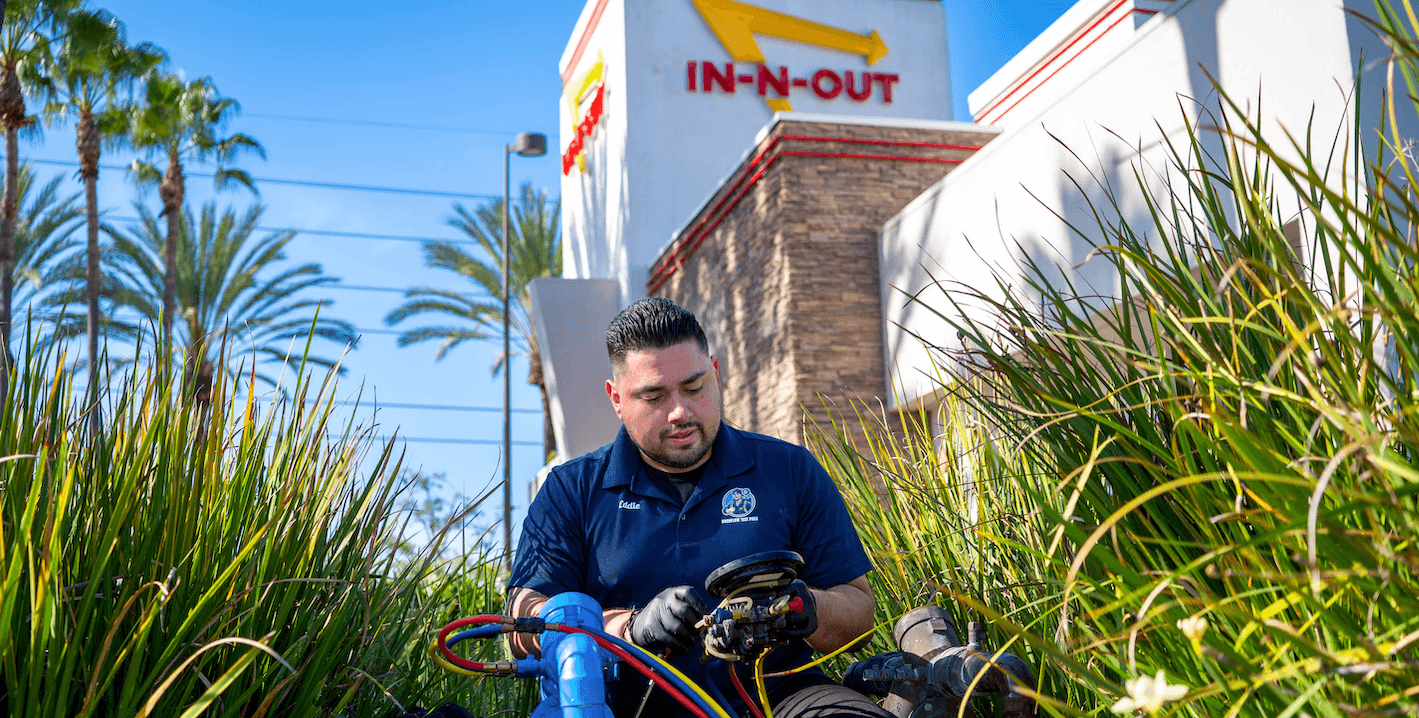


Restaurant & Food Services Backflow Installation Municipal Compliance
Ensure you're fully compliant with specific city, county and water districts backflow prevention requirements

Restaurants & Food Service Facilities must comply with California cross-connection control requirements as implemented by the local water purveyor. Restaurants and food service facilities (full-service restaurants, quick-service, cafés, bars, food courts, commercial kitchens, catering facilities, commissaries, bakeries, breweries with food service, and similar uses) are typically classified as high-hazard (health hazard) occupancies due to the presence of:
- food products and food-contact equipment - carbonated beverage systems and ice machines - dishwashers, pre-rinse units, mop sinks, and chemical cleaning - grease handling and janitorial washdown - frequent hose use and submerged hose potential Most California water purveyors require restaurants & food service facilities to have either premises containment (commonly an RP) for restaurants, and/or robust point-of-use backflow protection for specific equipment—often both. As a bonded and insured licensed contractors and certified backflow testing professionals specializing in the installation, testing and repair of commercial backflow prevention assemblies, Backflow Test Pros guarantees top-tier workmanship at the most competitive rates, provides backflow repair coverage and includes 2-year installation warranty to help you meet and exceed your restaurants & food service facility backflow installation, testing, repair compliance requirements.
Call for Your Free Restaurant & Food Services Compliance Review to Qualify for Installation Warranty, Best Value Testing, Repair Coverage & Multi-Device Discounts
Installing, testing and repair of backflow preventer devices in restaurants & food service facilities is a critical component of California’s commitment to water quality protection from commercial properties connected to a public potable water system. Restaurants & food service facility cross connection and backflow prevention responsibilities are governed by and subject to California Code of Regulations, Title 17, State Water Resources Control Board – Cross-Connection Control Policy Handbook (CCCPH), Plumbing Code and manufacturer requirements (air gaps, indirect waste, point-of-use protection), and local water purveyor cross-connection control programs (hazard classification, device selection, enforcement). Property owners are responsible for installation, testing, repair, and ongoing compliance. Hiring a certified backflow tester to perform Restaurants & Food Service Facility backflow prevention installation, testing and repair in a timely manner is key to ensuring compliance with state and municipal water department regulations. Backflow Test Pros is 100% dedicated to ensuring your property meets local water authority Restaurants & Food Service Facility backflow installation, testing and repair requirements so you can avoid civil penalties and ensure your water is not turned off for noncompliance. Ensure you're fully compliant with specific city, county and water districts backflow prevention requirements Ensure your backflow assembly installation clears local permitting requirements and plans approvals Ensure your installed backflow device is USC FCCCHR approved and meets hazard level requirements Free initial backflow certification testing, same-day report submittal and backflow repair coverage
Ensure you're fully compliant with specific city, county and water districts backflow prevention requirements

Ensure your backflow assembly installation clears local permitting requirements and plans approvals

Ensure your installed backflow device is USC FCCCHR approved and meets hazard level requirements

Free initial backflow certification testing, same-day report submittal and backflow repair coverage
We provide the best value in Restaurant & Food Services backflow prevention installations, testing and repair services by combining competitive pricing with premium service, warranty coverage and unmatched expertise.
Backflow Test Pros is an AWWA Certified Backflow Tester and Certified Backflow Tester with County Health Departments across Southern California. As a CA State licensed contractor and AWWA Certified backflow specialists, our team of experienced backflow experts work with County Health Boards and Municipal Water Departments throughout Southern California to protect our water and prevent backflow contamination.
The installation, inspection and testing of Restaurants & Food Service Facilities backflow preventer devices are essential for ensuring the safety of drinking water from contamination by moderate to high hazard facilities at restaurants & food service facilities. In California, restaurants & food service facility backflow preventer device installation, testing and repair is governed by a combination of state regulations and local ordinances, aiming to protect the public water supply from contamination. Understanding the types of restaurants & food service facility backflow installation, testing, and maintenance requirements helps you avoid civil liabilities and ensures water safety compliance.
Why Restaurants Are Treated as High Hazard Backflow Containment Risk
Restaurants routinely include multiple high-risk cross-connection conditions - Carbonated beverage dispensers (CO₂ pressure creates backpressure) - Dishwashers and pre-rinse spray units - Ice machines and make-up water lines - Mop sinks / janitorial closets with chemical mixing and submerged hoses - Hose bibbs for washdown near grease and waste areas - Grease interceptors and proximity to sanitary systems - Booster heaters / pressure systems - Outdoor kitchens and bar service (often with hoses and chemical cleaners)
Because food safety and public health impacts are severe if contamination occurs, purveyors generally apply health-hazard protection standards. Required Minimum Restaurants & Food Service Facility Backflow Risk Protection Level A. Reduced Pressure Principle Assembly Premises Containment at the Potable Service Connection - Protects against both backsiphonage and backpressure - Used where biological and chemical contaminants are present and where internal controls alone are insufficient In multi-tenant buildings or shopping centers, containment may be installed at the building service, but individual restaurant tenants often still require internal point-of-use protection regardless. B. Fire Protection Systems (If Present) - DCDA / DCVA sometimes allowed for “clean” systems - RPDA / RP required if additives exist or if the purveyor classifies the premises as high hazard C. Irrigation Systems (If Present) - PVB or RP depending on system design - RP commonly required where chemical injection or booster pumps exist Restaurant-Specific Point-of-Use Backflow Requirements Even with containment, point-of-use protection is critical in restaurants because most contamination risk originates at equipment. A. Carbonated Beverage Dispensers (Critical) Carbonators are one of the highest-risk devices in food service. Typical requirements:
- RP or approved carbonator backflow prevention assembly on the potable feed - In some jurisdictions, a dual-check with atmospheric vent may be allowed only if specifically approved by the purveyor - Improper protection of carbonators is a frequent enforcement issue B. Dishwashers & Pre-Rinse Units Common expectations:
- Protection per plumbing code and manufacturer instructions - Many installations rely on air gaps or integral backflow protection - Direct-connected dishwashers without proper protection are often cited C. Ice Machines - Water supply must be protected per manufacturer and plumbing code - Indirect waste with proper air gap is commonly required - Any chemical treatment or cleaning system connected to water may trigger additional protection D. Mop Sinks / Janitorial Closets / Chemical Mixing One of the most common violation areas:
- All hose connections must have hose bibb vacuum breakers or anti-siphon hose bibbs - Submerged hoses in buckets or sinks are prohibited - Chemical proportioners may require RP or air-gap arrangements depending on configuration E. Hose Bibbs / Washdown Connections - Exterior and interior hose bibbs must be protected against backsiphonage - Pressure washing near grease areas significantly elevates risk
Restaurants & Food Service Facilities Backflow Violation Enforcement & Penalties
Local water purveyors typically:
- issue notices and compliance deadlines - assess administrative penalties (varies) - require re-inspection or cross-connection surveys - terminate water service for failure to install, test, or maintain required backflow protection
Restaurants often face short compliance timelines due to food safety implications.
Additional Civil Liabilities
Property owners and restaurants & food service facilities operators are exposed to additional civil liabilities resulting from contamination in the event of failure to prevent backflow into the potable water resources used by other parties.
Backflow preventers are devices installed at specific points in restaurants & food service facilities where the premise or specific equipment connect to the public water supply. Backflow prevention devices allow water to flow in one direction. They shut off or redirect the flow if backpressure or backsiphonage is detected.
Restaurants & Food Service Facility Backflow Prevention Installation Requirements
A. Purveyor Review & Approval - Water purveyor determines hazard classification and required device types - Tenant improvements and equipment changes often trigger re-evaluation B. Permits & Acceptance Testing - Plumbing permits typically required for new installations - New/relocated/repaired assemblies must be tested immediately and accepted C. Location & Accessibility - Assemblies must be accessible for testing and repair - RP relief discharge must not flood kitchens or create health hazards - Avoid installation in grease-prone or flood-prone areas without proper drainage D. Common Installation Deficiencies - Carbonators without approved backflow protection - RPs installed where relief discharge floods kitchen spaces - Inaccessible assemblies behind walls or equipment - Unapproved device models or incorrect orientation In most jurisdictions, Restaurants & Food Service Facilities are required to install an approved backflow prevention device—such as a pressure vacuum breaker (PVB), double check valve assembly (DCVA), or reduced pressure zone (RPZ) device—at the point where the restaurants & food service facility connects to the potable water supply. Additionally, state and municipal regulations require that Restaurants & Food Service Facilities backflow prevention devices be tested annually by a certified backflow tester to ensure proper operation. Installation must also follow strict guidelines regarding height, orientation, and accessibility to allow for inspection and servicing.
Restaurants & Food Service Facility Backflow Prevention Testing Requirements A. Routine Testing Frequency
- At least annually for all testable assemblies:
- domestic containment (RP) - fire assemblies (if present) - irrigation assemblies (if present) - point-of-use assemblies where testable B. Triggered Testing (Always Required)
Testing required:
- immediately after installation - after repair/rebuild - after relocation - after replacement - after plumbing modifications affecting protected lines - after a suspected backflow event C. Tester Qualification & Reporting - Testing must be performed by jurisdiction-recognized certified testers - Reports must be submitted via the purveyor’s required method by the due date Restaurants & Food Service Facility Backflow Prevention Repair & Failure Response Requirements A. Corrective Action if an assembly fails:
- repair or replace promptly - retest to confirm passing operation - unresolved failures may result in enforcement or service interruption B. Repair Standards
- Manufacturer-approved parts and kits only - No field modifications compromising listing/approval C. Replacement Triggers
Replacement is required when:
- repeated failures occur - corrosion or internal damage exists - assembly is obsolete or no longer accepted - location/access issues cannot be corrected without replacement
Failure to comply with these restaurants & food service facilities backflow installation, testing and repair regulations can result in fines, disconnection of service, or other enforcement actions. Restaurants & Food Service Facilities owner operators may call us or consult their local water authority or building department to ensure their restaurants & food servicemeets all applicable backflow prevention requirements.
Because Restaurants & Food Service Facilities typically have many High-Risk backflow containment conditions it is important that you perform an extensive cross connection and backflow prevention compliance review to avoid penalties, water disruptions and civil liabilities.
Common Restaurant Deficiencies That Trigger Backflow Containment Violation Enforcement - unprotected carbonated beverage systems - submerged hoses in mop sinks or buckets - unprotected hose bibbs - chemical proportioners without approved protection - overdue annual testing - equipment added during remodels without backflow review Call Us for Your Free Restaurants & Food Service Facility Backflow Compliance Review to Ensure You are Not in Violation State or Local Backflow Prevention Requirements 1. Confirm hazard classification (restaurants are typically health hazard). 2. Install required RP containment if mandated by the purveyor. 3. Verify carbonated beverage dispensers have approved backflow protection. 4. Ensure all hose connections have vacuum breakers. 5. Confirm dishwashers and ice machines meet air-gap / protection requirements. 6. Test all assemblies annually and after install/repair/relocation. 7. Submit reports on time and maintain records. 8. Repair failures immediately and retest. 9. Re-evaluate backflow protection after remodels or equipment changes.