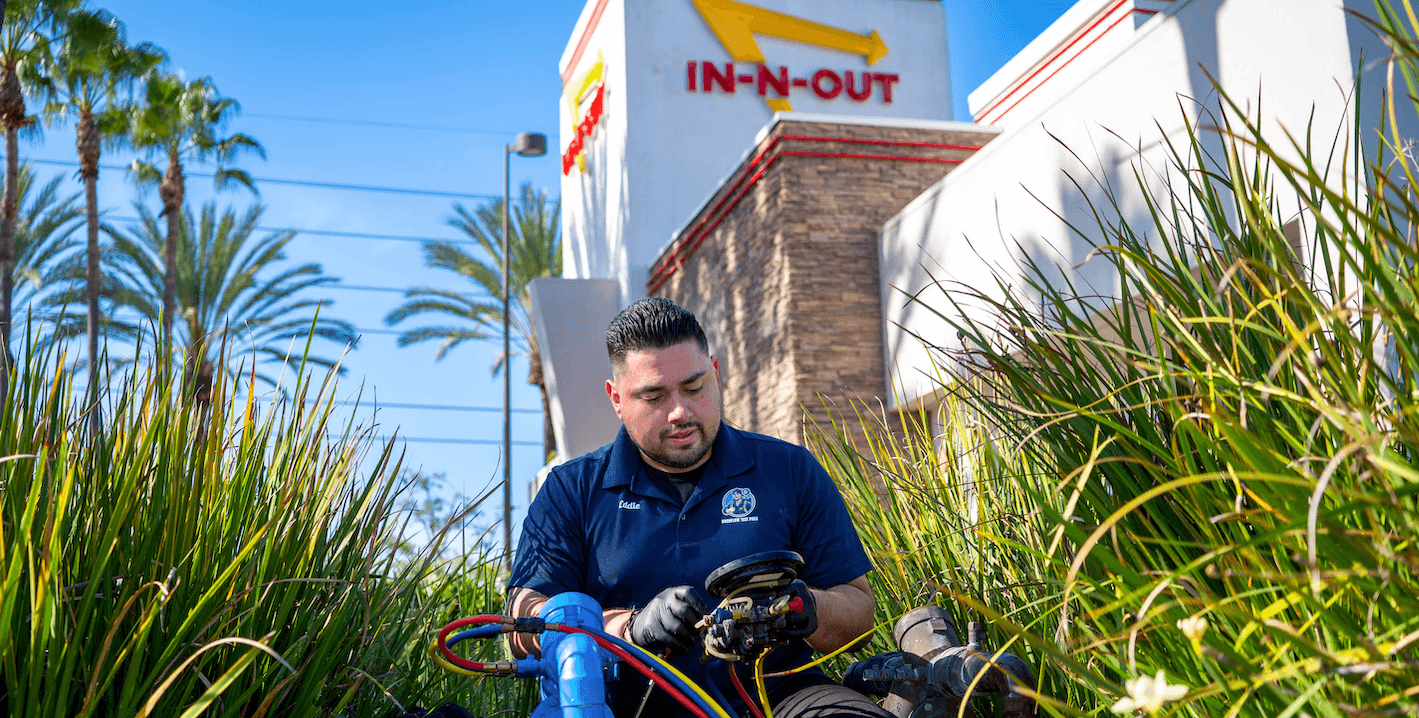


Residential Community HOA Backflow Installation Municipal Compliance
Ensure you're fully compliant with specific city, county and water districts backflow prevention requirements

HOA communities are often regulated through common-area services rather than individual homes. The most common backflow obligations are for irrigation, pools/spas, clubhouse buildings, and fire services. HOAs must maintain multiple backflow assemblies, each with annual testing and reporting. As a bonded and insured licensed contractors and certified backflow testing professionals specializing in the installation, testing and repair of commercial backflow prevention assemblies, Backflow Test Pros guarantees top-tier workmanship at the most competitive rates, provides backflow repair coverage and includes 2-year installation warranty to help you meet and exceed your Residential Community HOA backflow installation, testing, repair compliance requirements.
Call for Your Free Residential Community HOA Compliance Review to Qualify for Installation Warranty, Best Value Testing, Repair Coverage & Multi-Device Discounts
Residential HOA communities include: - Single-family subdivisions with HOA-maintained common areas - Gated communities with private streets and landscape systems - Planned Unit Developments (PUDs) with shared amenities - Master-planned communities with multiple irrigation meters and facilities - HOAs with common facilities (pools/spas, clubhouses, parks, community centers) Installing, testing and repair of backflow preventer devices in Residential Community HOAs is a critical component of California’s commitment to water quality protection from commercial properties connected to a public potable water system. Residential Community HOA cross connection and backflow prevention responsibilities are governed by and subject to CCR Title 17 cross-connection control expectations (as administered by water purveyors), The State Water Board’s Cross-Connection Control Policy Handbook (CCCPH) (statewide minimum program expectations), the local water purveyor cross-connection programs (hazard classification, device selection, enforcement), and California state plumbing code and equipment manufacturer requirements. Residential Community HOA manager operators are responsible for installation, testing, repair, and ongoing compliance. Hiring a certified backflow tester to perform Residential Community HOA backflow prevention installation, testing and repair in a timely manner is key to ensuring compliance with state and municipal water department regulations. Backflow Test Pros is 100% dedicated to ensuring your property meets local water authority Residential Community HOA backflow installation, testing and repair requirements so you can avoid civil penalties and ensure your water is not turned off for noncompliance. Ensure you're fully compliant with specific city, county and water districts backflow prevention requirements Ensure your backflow assembly installation clears local permitting requirements and plans approvals Ensure your installed backflow device is USC FCCCHR approved and meets hazard level requirements Free initial backflow certification testing, same-day report submittal and backflow repair coverage
Ensure you're fully compliant with specific city, county and water districts backflow prevention requirements

Ensure your backflow assembly installation clears local permitting requirements and plans approvals

Ensure your installed backflow device is USC FCCCHR approved and meets hazard level requirements

Free initial backflow certification testing, same-day report submittal and backflow repair coverage
We provide the best value in Residential Community HOA backflow prevention installations, testing and repair services by combining competitive pricing with premium service, warranty coverage and unmatched expertise.
Backflow Test Pros is an AWWA Certified Backflow Tester and Certified Backflow Tester with County Health Departments across Southern California. As a CA State licensed contractor and AWWA Certified backflow specialists, our team of experienced backflow experts work with County Health Boards and Municipal Water Departments throughout Southern California to protect our water and prevent backflow contamination.
While the homes themselves are typically “residential domestic” use, HOAs often operate multiple water services (irrigation, pool fill, clubhouse, fire lines) that can introduce moderate-to-high hazard backflow risks.
Backflow Risk at Residential Communities Arise from the following Shared Amenities and Systems:
Common risk drivers include:
- Irrigation systems (parks, medians, slopes, golf-course-style landscaping) - Pool/spa systems (chemical treatment, makeup water connections) - Clubhouse kitchens/bars (if present) - Maintenance washdown (hoses at parks, restrooms, trash enclosures) - Fire protection services (antifreeze additives in some systems) - Private water distribution (rare, but some HOAs have master meters or private distribution systems) - Reclaimed/nonpotable irrigation water (some communities have purple-pipe systems) Because residential communities combine many potential cross-connection points, purveyors often apply conservative containment. Risk is typically backsiphonage (submerged hoses, irrigation zone failures) and, where booster pumps exist, backpressure. Residential Communities Typically Require the Following Minimum Level Backflow Risk Protections Because HOAs often have multiple services, enforcement may be targeted to the noncompliant meter rather than the entire community. Individual homes typically fall under separate residential accounts and are not managed by the HOA unless the community is master-metered.
A. Domestic Potable Service (Common-Area Buildings Only) - DC is commonly allowed for standard domestic use - RP may be required if higher hazard features exist (commercial kitchen, chemical feed, hydronic loop, etc.)
B. Irrigation Services (Most Common HOA Backflow Requirement) - PVB (Pressure Vacuum Breaker) commonly used/allowed for irrigation (if local standards allow)
- RP required if:
- chemical injection/fertigation exists - booster pumps are installed - auxiliary water sources (wells, reclaimed water interties) exist - irrigation is connected to ponds/lakes or other nonpotable sources - purveyor classifies the system as higher hazard Many HOAs have multiple irrigation meters; each may require its own backflow assembly and annual testing. C. Pools / Spas / Splash Pads / Water Features (Common)
- Makeup water protection requirements vary widely by purveyor and design.
- Many purveyors require RP for pool/spa makeup water connections, especially where chemical feed is present or where there is any risk of cross-connection.
- Some systems are designed using air-gap-type arrangements depending on configuration and local requirements. D. Fire Protection Systems (If HOA Owns Fire Services for Common Buildings)
- DCDA/DCVA often allowed for “clean” sprinkler systems - RPDA required if antifreeze/additives exist - Some purveyors require RPDA based on overall premises hazard classification
Residential Community HOA-Specific Internal (Point-of-Use) Protection Areas A. Irrigation System Components & Common Fail Points (Highest Priority) Risk drivers:
- zone valves and quick couplers used by landscapers - hose connections tied into irrigation lines - repairs that bypass or remove protection - booster pumps installed after initial buildout Typical expectations:
- Maintain correct device type (PVB vs RP) per design/hazard - PVB elevation/clearance requirements met (where applicable) - Assemblies protected from vandalism and vehicle impact - No unapproved cross-ties to domestic water without purveyor review
B. Pool / Spa Equipment Rooms and Fill Connections Risk drivers:
- chemical treatment (chlorine/bromine) - hose filling practices in equipment rooms - cross-ties between domestic and pool recirculation systems Typical expectations:
- Makeup water protected per purveyor/manufacturer design - Hoses protected (vacuum breakers) and not submerged - No cross-connections between treated pool water and potable supply C. Maintenance Hose Bibbs, Parks, Restrooms, and Trash Enclosures Risk drivers:
- submerged hoses in buckets/chemical sprayers - washdown near trash and animal waste areas - hose-end attachments/splitters that defeat protection Typical controls:
- Anti-siphon hose bibbs / hose bibb vacuum breakers - Secure hose connections where misuse is common - Operational controls to prevent submerged hoses D. Clubhouse Kitchens / Bars / Dishwashers (If Present) Risk drivers:
- detergents/sanitizers - beverage systems - improper drains/air gaps for equipment Typical expectations:
- Indirect waste/air gaps where required by plumbing code/manufacturer - Chemical dispensers installed with required protection - Any required containment (DC/RP) tested annually E. Reclaimed / Nonpotable Irrigation (If Present) Risk drivers:
- potable/nonpotable cross-connection risk - maintenance tie-ins and temporary connections Typical expectations:
- Strict separation, labeling, and purveyor oversight - Unapproved interconnections treated as serious violations - Specific local requirements are typically stringent
Residential Community HOA Backflow Violation Enforcement & Penalties
Because HOAs often have multiple services, enforcement may be targeted to the noncompliant meter rather than the entire community.
Local water purveyors typically may:
- issue notices and compliance deadlines - assess administrative fees/penalties (varies) - require inspections/cross-connection surveys - terminate service to specific meters (often irrigation) for noncompliance
Additional Residential Community HOA Backflow Violation Civil Liabilities
Residential Community HOA operators are exposed to additional civil liabilities resulting from contamination in the event of failure to prevent backflow into the potable water resources used by other parties.
The installation, inspection and testing of Residential Community backflow preventer devices are essential for ensuring the safety of drinking water from contamination by moderate to high hazard facilities at Residential Communities. Residential Community HOA Backflow Installation Requirements A. Purveyor Hazard Review & Device Approval
Purveyor Hazard Review & Device Approval - Purveyor determines device requirements per service (irrigation, pool, clubhouse) - Landscape renovations, adding quick couplers, installing pumps, or pool remodels may trigger re-review B. Permits & Acceptance Testing - Plumbing permits typically required for installation/modification - New/relocated/repaired testable assemblies must be tested immediately and accepted C. Location & Accessibility - Assemblies must be accessible for annual testing/repair - Avoid flood-prone pits/vaults unless approved drainage is provided - Provide protective enclosures/bollards where devices are exposed to traffic/vandalism D. Common Installation Deficiencies - PVBs installed too low or without required clearance/elevation - RPs installed in vaults subject to flooding/submergence - Assemblies hidden behind landscaping or locked without access - Inadequate drainage for RP relief discharge - Unauthorized bypass piping around devices
Residential Community HOA Backflow Testing Requirements A. Routine Testing Frequency
- At least annually for all testable assemblies:
- irrigation (PVB/RP) - clubhouse/domestic (DC/RP if applicable) - fire (DCDA/RPDA) - pool/spa makeup assemblies (if testable and required) Some purveyors require more frequent testing for higher hazard sites or repeated failures. B. Triggered Testing (Always Required) Testing required:
- immediately after installation - after repair/rebuild - after relocation - after replacement - after irrigation or plumbing modifications - after suspected backflow incident or cross-connection discovery C. Tester Qualification & Reporting - Certified tester recognized/approved by the purveyor (often requiring registration) - Reports submitted via required portal/forms by deadline - HOAs should maintain a centralized compliance log (multiple meters/devices is common) Residential Community HOA Backflow Repair & Failure Response Requirements A. Corrective Action If an assembly fails:
- repair or replace promptly - retest to confirm passing operation - unresolved failures can lead to enforcement and possible service interruption (especially irrigation services) B. Repair Standards
- Manufacturer-approved parts and rebuild kits only - No field modifications compromising approval/listing - Maintain shutoffs/test cocks and access clearances C. Replacement Triggers
Replacement commonly required when:
- repeated failures occur - device is damaged (vandalism, vehicle strike) - corrosion/cracking compromises integrity - device becomes obsolete/non-accepted - location/access/drainage issues require relocation/replacement
Failure to comply with these Residential Community related backflow installation, testing and repair regulations can result in fines, disconnection of service, or other enforcement actions. Residential Community HOA managers operators may call us or consult their local water authority or building department to ensure their HOA meets all applicable backflow prevention requirements.
Because HOAs often have multiple services, enforcement may be targeted to the noncompliant meter rather than the entire community—unless a serious cross-connection is found.
Residential Community HOA Deficiencies That Trigger Enforcement
- Overdue annual testing for irrigation backflow assemblies - PVBs installed incorrectly (height/clearance violations) - Devices blocked by landscaping or inaccessible behind locked gates - Missing protective enclosures/bollards; devices damaged by landscaping equipment - Irrigation system modifications (new quick couplers, pumps) without purveyor review - Pool/spa makeup connections lacking required protection - Hose bibbs lacking vacuum breakers at parks/trash enclosures - Unapproved bypass piping around assemblies
Call Us for Your Residential Community Backflow Compliance Review to Ensure You are Not in Violation of State and Local backflow Prevention Requirements 1. Identify all HOA-controlled services/meters: irrigation, clubhouse/domestic, pool/spa, fire. 2. Confirm device type required for each service (PVB vs RP for irrigation; DC/RP for buildings; DCDA/RPDA for fire). 3. Ensure all assemblies are accessible, protected, and not flood-prone (especially RPs). 4. Verify PVB installations meet elevation/clearance requirements where applicable. 5. Install vacuum breakers on hose bibbs in parks, restrooms, and maintenance areas. 6. Test all assemblies annually and after any installation/repair/relocation/modification. 7. Submit reports on time and maintain a master compliance binder/log. 8. Repair failures promptly and retest. 9. Re-evaluate after landscape renovations, pool remodels, or pump/quick-coupler additions.